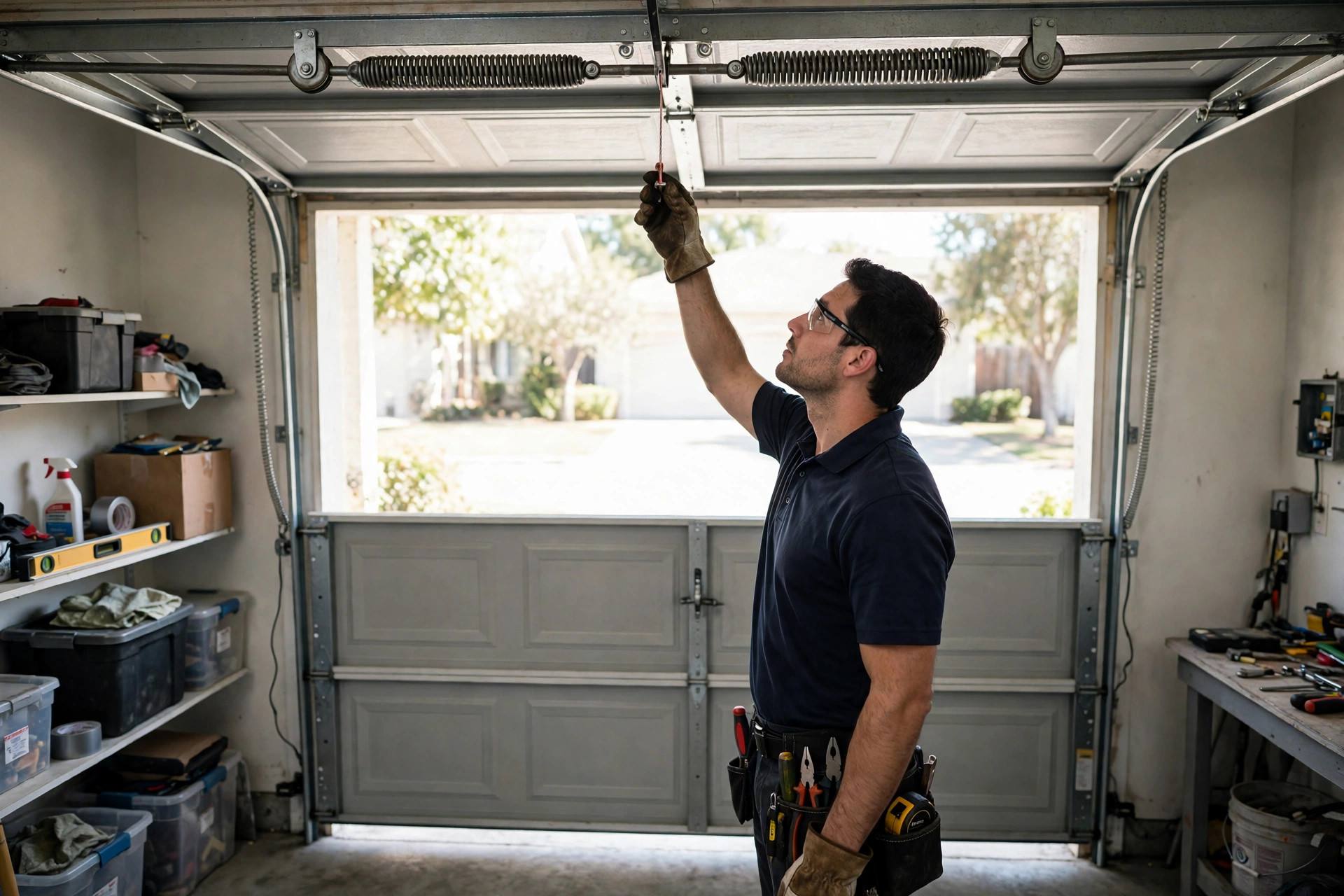
Spring Adjustment and Door Balancing
Spring Adjustment and Door Balancing: what it fixes, how it is diagnosed, and what to check first before any part is replaced.
What this service fixes
Not every spring problem is a broken spring. Springs lose tension gradually, cables stretch slightly, and a door that once balanced perfectly starts to drift: it falls closed from halfway, creeps upward on its own, or slams the last few inches.
The balance test tells the story in seconds. With the opener disconnected, lift the door to halfway and let go. A balanced door stays where you left it. A door that falls or rises has a tension problem, and adjusting the spring tension, rather than replacing the opener, is usually the fix.
Three things that decide whether this job is done right
- Adjustment is measured in small increments, and the door is re-tested after each one. Large jumps in tension overshoot the balance point and put extra load on the cables and opener.
- Balance is checked at several heights, because a door can sit still at halfway and still drift near the top or bottom. The full travel matters, not a single test point.
- Cable tension must stay even on both sides during adjustment. Uneven cables pull the door sideways in its tracks, which wears rollers and can bend a track over time.
- If adjustment cannot hold a balance, the spring itself is usually fatigued and replacement, not more adjustment, is the honest recommendation. Adjusting a worn-out spring further only buys a short time and risks a break.
How the job is carried out
- Run the balance test with the opener disconnected and note exactly where the door drifts.
- Adjust spring tension in small increments, re-testing the balance after each change.
- Even out cable tension on both drums so the door tracks level through its travel.
- Reconnect the opener and test full travel, force settings and safety reverse after the adjustment.
- Show the homeowner the balance test so they can repeat it safely and spot the next drift early.
What is checked first
The technician checks balance at several heights, cable tension on both drums, roller condition, and whether the door binds anywhere in its tracks before calling the adjustment done.
What goes wrong if the job is delayed
An unbalanced door makes the opener do the spring's job. That wears the opener gear, strains the rail, and can pull cables off their drums, so a simple adjustment delayed often becomes an opener repair as well.
What is included, and what is not
Included: Balance test, spring tension adjustment in measured increments, cable tension evening, and a full travel and safety-reverse test.
Not included: No price or arrival time is stated on the Spring Adjustment and Door Balancing page, because neither has been supplied for this business. If the spring is fatigued beyond adjustment, replacement is quoted separately before work starts.
Questions customers ask about this service
How do I test my door's balance safely?
Disconnect the opener, lift the door to halfway by hand, and let go. A balanced door stays put. Do this test only if the door is not broken, jammed or hanging crooked, and never stand under the door while testing it.
My door closes fine but slams the last few inches. Is that a balance problem?
Usually, yes. A door that accelerates at the bottom has too little spring assistance at that part of the travel, or a cable tension imbalance. It is worth adjusting before the slam damages the bottom panel or the opener rail.
Can I adjust the springs myself?
No. Torsion springs hold enough tension to cause serious injury, and extension springs under load are also dangerous. The balance test is a safe homeowner check; winding or tensioning is technician work, and the safety guide on this site draws that line in detail.
Call for this service
Call (877) 318-0816 for spring adjustment and door balancing help.
Massachusetts ZIP pages for this service: Warren 01083, Ashburnham 01430, Gardner 01440, Lunenburg 01462, West Townsend 01474, Brookfield 01506, Grafton 01519, Millbury 01527
Related services: