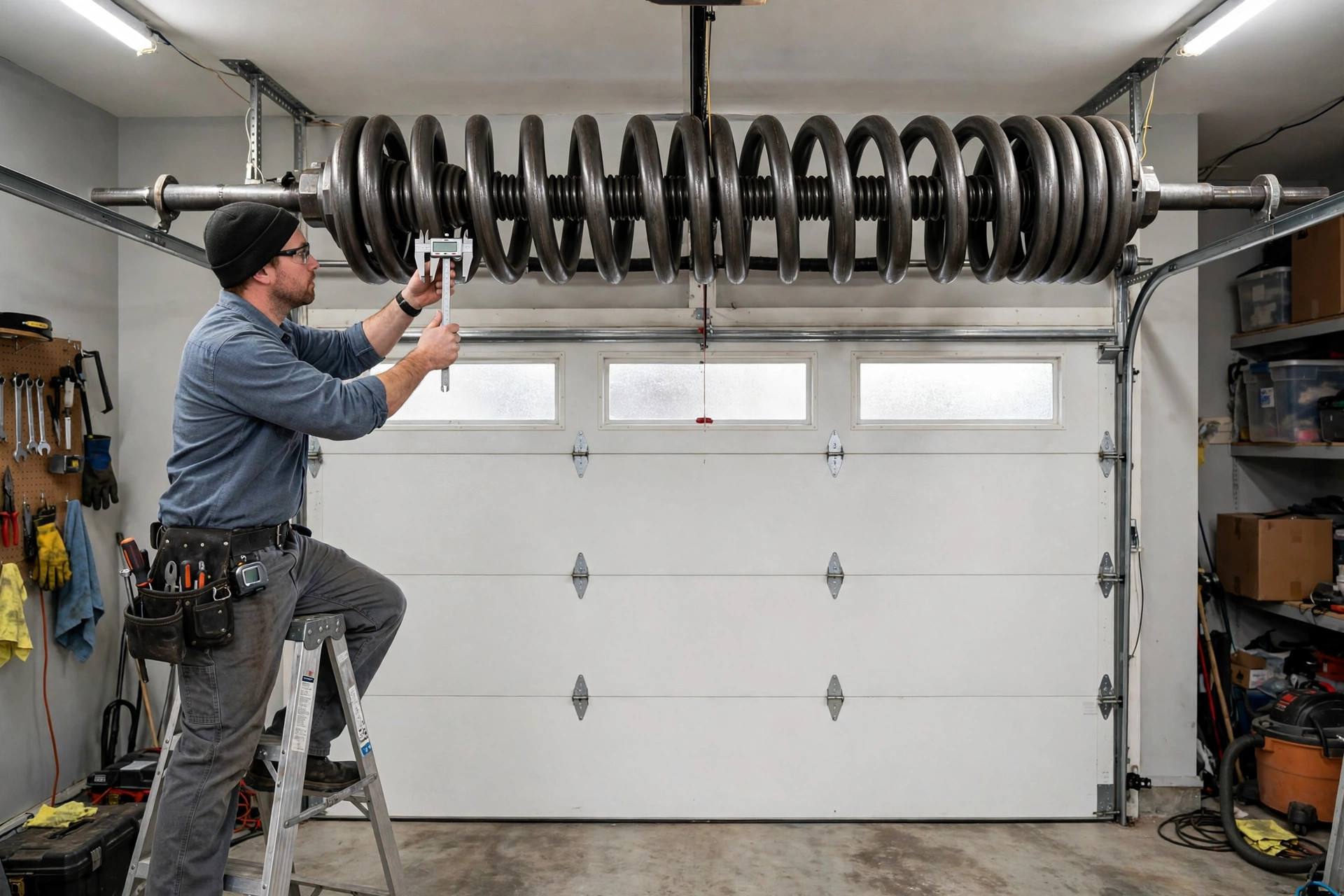
High-Cycle Spring Upgrade
High-Cycle Spring Upgrade: what it fixes, how it is diagnosed, and what to check first before any part is replaced.
What this service fixes
A spring's life is measured in cycles: one open and one close. Standard residential springs are commonly rated around ten thousand cycles, while high-cycle springs are built with thicker wire or longer coils to reach ratings such as twenty thousand, twenty-five thousand or fifty thousand cycles.
The upgrade question is really a usage question. A door used twice a day lasts many years on a standard spring. A door that is the household's main entrance, used ten or more times a day, can burn through a standard spring's cycles in a few years, and a high-cycle spring is the straightforward way to stretch that interval.
Three things that decide whether this job is done right
- Cycle rating is not a promise of years; it is a count of uses. Two households with the same spring can get very different lifespans purely from how often the door cycles each day.
- High-cycle springs are larger and heavier for the same door, so the shaft, drums and bearings are checked before an upgrade. A heavier spring on worn bearings is a poor upgrade.
- The spring must still balance the door exactly. A high-cycle spring sized only by its rating, without matching wire size, inside diameter, length and wind to the door, will not balance, no matter how many cycles it is rated for.
- Upgrading the spring alone does not upgrade the opener, cables or rollers. Those parts are inspected at the same visit, because a long-life spring on tired cables still leaves the weakest link in place.
How the job is carried out
- Count the door's real daily use with the homeowner and work out how quickly a standard spring's cycles are consumed.
- Measure the door and existing springs, and select a high-cycle spring that matches the door's weight and geometry.
- Check shaft, drums and bearings for the heavier spring, and replace worn hardware found during that check before fitting.
- Fit, wind and balance the new spring, then test balance at several heights and the full opener travel.
- Explain the cycle rating in plain terms: what it counts, what it does not guarantee, and what to watch for as the spring ages.
What is checked first
The technician checks daily cycle use, door weight, spring geometry, shaft and bearing condition, and balance at several heights before and after the upgrade.
What goes wrong if the job is delayed
Staying on a standard spring for a very high-use door means more frequent breaks, and each break is an emergency with a stuck door. The upgrade is planned work; the break it prevents is not.
What is included, and what is not
Included: High-cycle spring matched to the door, hardware inspection for the heavier spring, winding and balancing, and a full travel and safety-reverse test.
Not included: No price or arrival time is stated on the High-Cycle Spring Upgrade page, because neither has been supplied for this business. Hardware replacement found necessary during inspection is quoted separately before extra work starts.
Questions customers ask about this service
How many cycles does my door use each day?
Count every open and close as one cycle each way, or simply count full open-close trips. A door used as the main entrance often cycles eight to fifteen times a day, while a rarely used door may cycle once or twice.
Does a high-cycle spring make the door open faster?
No. A correctly sized high-cycle spring balances the door exactly like a standard spring. The difference is durability over many cycles, not speed or force.
Is a high-cycle spring worth it for a rarely used door?
Usually not. On a door that cycles once a day, a standard spring already lasts many years, and the extra size and cost of a high-cycle spring buys little. The upgrade pays off on high-use doors.
Call for this service
Call (877) 318-0816 for high-cycle spring upgrade help.
Massachusetts ZIP pages for this service: Barre 01005, Gilbertville 01031, Hardwick 01037
Related services: